Planning a trip to Japan between December 29, 2026, and January 4, 2027? Find out what’s open and closed, how trains and restaurants operate, and how to plan your sightseeing during Japan’s New Year holiday.
Disclosure: This article contains affiliate links.
Last updated: October 20, 2026
If you’re visiting Japan over New Year, you may be wondering whether restaurants will be open, whether you can visit famous attractions, and whether trains will run as usual.
The good news is that Japan does not shut down completely. Many shrines, temples, hotels, convenience stores, and public transportation services continue operating. However, opening hours vary, and some museums, independent restaurants, local shops, banks, and offices close for several days.
The key is to plan ahead, especially if you’re arriving on January 1 or traveling between cities during the holiday period.
This guide covers December 29, 2026, through January 4, 2027, with practical tips to help you make the most of your winter trip.
- Quick Answer: Japan New Year 2026–2027 at a Glance
- 1. When Is the New Year Holiday in Japan?
- 2. What’s Usually Open and Closed?
- 3. Are Restaurants Open During New Year?
- 4. Can You Visit Tourist Attractions on January 1?
- 5. Are Shops and Shopping Malls Open?
- 6. Will Trains and Public Transportation Run?
- 7. Cash, ATMs, and Coin Lockers
- 8. Should You Book Hotels and Activities in Advance?
- 9. A Simple Japan New Year Travel Plan
- 10. Your Pre-Trip Checklist
- Frequently Asked Questions
- Is Japan closed from December 29 to January 3?
- Is January 1, 2027, a public holiday in Japan?
- Are convenience stores open on New Year’s Day?
- Will trains run on New Year’s Day?
- Are there all-night trains on New Year’s Eve?
- When do shops reopen after New Year?
- Is Tokyo Disney Resort holding a New Year’s Eve event in 2026?
- Can I visit the Imperial Palace during New Year?
- Is there a New Year’s Eve countdown party in Japan?
- Should I withdraw cash before the holiday?
- Is Japan worth visiting during New Year?
- Final Thoughts: Is Japan Worth Visiting During New Year?
Quick Answer: Japan New Year 2026–2027 at a Glance
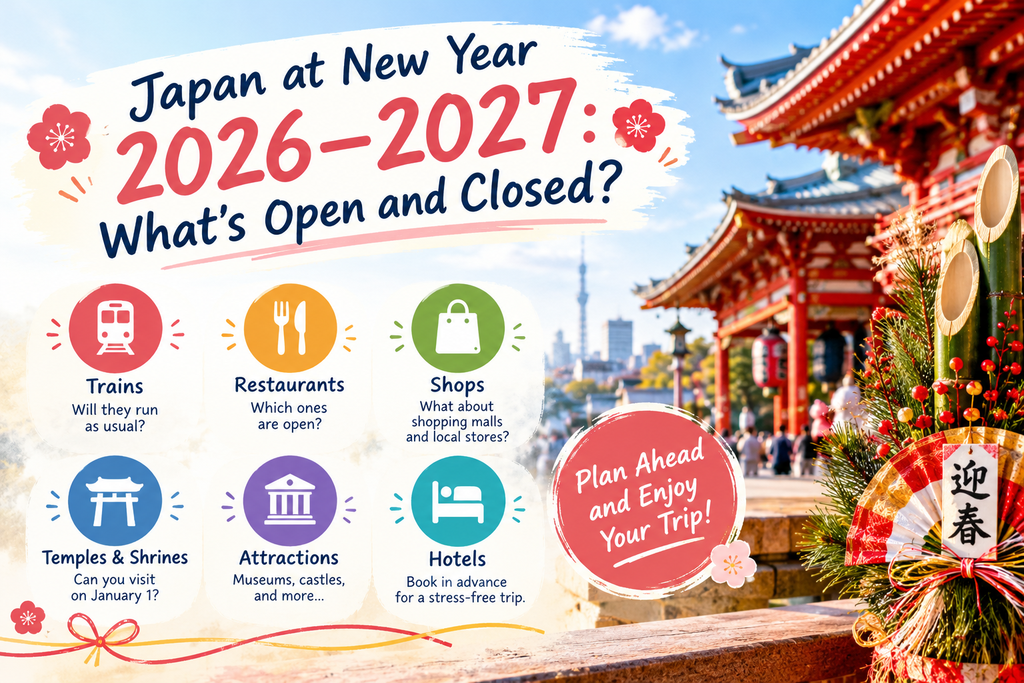
Planning a trip to Japan over New Year? Check opening hours, transportation, and available activities before you go.
- Main holiday period: Many offices and businesses close around December 29 through January 3, but dates vary.
- National public holiday: Friday, January 1, 2027.
- January 1: Many businesses and attractions may be closed or operate on special schedules.
- Shrines and temples: Many welcome visitors for hatsumode, the first shrine or temple visit of the year.
- Restaurants: Some chain restaurants and hotel restaurants operate, while many independent restaurants take a holiday break.
- Shopping: Some department stores reopen for first-sale events on January 2 or later.
- Trains: Services generally continue, but holiday timetables and heavy passenger demand can affect your journey.
- Shinkansen: Nozomi trains between Tokyo and Hakata are scheduled to operate with reserved seats only from December 25, 2026, through January 5, 2027.
- Best planning tip: Confirm opening hours, reserve essential transportation and activities, and keep backup options for meals and sightseeing.
These are general patterns, not guarantees. Always check official information for the specific place, service, and date you plan to use.
1. When Is the New Year Holiday in Japan?
Japan’s New Year holiday is one of the country’s major holiday periods. Many government offices, banks, and private businesses close for several days, but not every business follows the same schedule.
Here’s what to expect around the end of 2026 and the beginning of 2027.
- Tuesday, December 29, 2026: Some offices and businesses begin their holiday closures. Many shops and attractions may still be open.
- Wednesday, December 30: More businesses may begin closing, and travel demand can increase.
- Thursday, December 31 — Omisoka: New Year’s Eve. Some restaurants and shops may close early. Certain temples hold traditional bell-ringing ceremonies.
- Friday, January 1, 2027 — New Year’s Day: A national public holiday. Many businesses close or operate on special schedules.
- Saturday, January 2: Some department stores reopen for New Year sales. Check the latest announcement for the Imperial Palace New Year Greeting before planning a visit.
- Sunday, January 3: Some businesses remain closed, while travel demand may be high.
- Monday, January 4: Many offices resume work, but individual businesses and attractions may still follow their own holiday schedules.
These dates describe common patterns rather than guaranteed opening dates. If a particular restaurant, museum, shop, or attraction is important to your trip, check its official website before visiting.
For general guidance, see the Japan National Tourism Organization’s Business Hours and Holidays guide.
2. What’s Usually Open and Closed?
The table below is a general planning guide. Individual opening hours vary by business, location, and year.
| Place or service | December 31 | January 1 | January 2–3 |
|---|---|---|---|
| Shrines and temples | Many welcome visitors; some hold special events | Many welcome visitors for hatsumode | Many remain open; crowds vary |
| Convenience stores | Many open | Many open | Many open |
| Trains and subways | Services operate; check the last train | Services generally operate on holiday schedules | Services operate; crowding varies |
| Hotels | Generally operating; check individual services | Generally operating; check individual services | Generally operating |
| Hotel restaurants | Check meal times and reservations | Check meal times and reservations | Check holiday schedules |
| Department stores | Some close early | Many close | Some reopen on January 2 or 3 |
| Shopping malls | Hours vary | Hours vary | Hours vary |
| Independent restaurants | Some close early or for the holiday | Many may be closed | Some may remain closed |
| Chain restaurants | Many operate, but hours vary | Some operate with special hours | Many operate, but hours vary |
| Museums and galleries | Many have holiday closures | Many are closed | Some remain closed |
| Supermarkets and food markets | Hours vary | Many may be closed or have reduced hours | Hours vary |
| Banks and government offices | Generally closed for the holiday period | Closed | Generally closed through the holiday period |
The most important rule is simple: don’t assume a business will be open just because it normally operates on that day of the week.
Check the official website or contact the business directly if you need certainty.
3. Are Restaurants Open During New Year?
Some restaurants remain open, but finding a convenient place to eat can require more planning than usual.
Restaurants inside major hotels, busy railway stations, and large commercial complexes may operate during the holiday. Some chain restaurants also remain open, although hours differ by location.
Independent restaurants, family-run businesses, and smaller local eateries may close for several days so their owners and staff can celebrate with their families.
How to Avoid Meal-Time Problems
- Check the restaurant’s official website or current listing for holiday opening hours.
- Make reservations for restaurants that are important to your trip.
- Confirm hotel restaurant availability for December 31 and January 1, especially if you want a special dinner.
- Identify a backup restaurant or food option near your hotel.
- Consider station buildings, food courts, and chain restaurants if your first choice is closed.
- Carry a few snacks in case you have a long journey or find fewer food options than expected.
Convenience stores can be useful for drinks, snacks, and simple meals. However, they may not replace a full restaurant meal or a special New Year’s dinner.
Practical tip: If you arrive in Japan on January 1, decide where you will eat before leaving your hotel. This is especially important if you’re staying outside a major city center.
4. Can You Visit Tourist Attractions on January 1?
Yes, you may still be able to enjoy sightseeing during New Year. The best options depend on your destination and the opening hours of individual attractions.
Shrines and Temples: Experience Hatsumode
New Year is an important time to visit shrines and temples in Japan.
The first shrine or temple visit of the year is called hatsumode. Many people visit between January 1 and January 3 to pray for health, happiness, and good fortune.
Popular locations can attract large crowds. Some sites use designated walking routes, temporary barriers, or other crowd-control arrangements.
To make your visit easier:
- Visit early if the site permits access at that time.
- Allow extra time for queues and walking.
- Follow posted signs and staff instructions.
- Check whether the site has special visiting hours or access restrictions.
- Dress warmly if you expect to wait outdoors.
If you’d like to explore Japan with a guided experience, browse Japan tours and activities on Viator. Check the available dates and details before booking, as some tours may not operate during the New Year holiday.
New Year’s Eve Temple Bells and the First Sunrise
Some Buddhist temples hold Joya no Kane, a traditional New Year’s Eve bell-ringing ceremony. The bell is traditionally rung 108 times, symbolizing the letting go of worldly desires.
Not every temple offers public access to the ceremony. Some limit visitor numbers or require reservations, so confirm the arrangements before going.
Another Japanese New Year tradition is hatsuhinode, watching the first sunrise of the year. People gather at beaches, hills, and scenic viewpoints to welcome the new year.
If you plan to watch the sunrise from an observation deck or a ticketed attraction, check whether advance reservations are required and confirm the opening time.
The Imperial Palace New Year Greeting in Tokyo
The Imperial Palace New Year Greeting is a special annual event in which members of the Imperial Family appear before visitors.
The event is traditionally held on January 2, but check the Imperial Household Agency’s official announcement before treating the 2027 schedule as confirmed.
If attending is important to your trip, visit the Imperial Household Agency’s official website for the date, entry arrangements, schedule, and security requirements.
Large crowds and security checks may affect the time needed for a visit.
Tokyo Disney Resort
Tokyo Disney Resort has announced that its special “New Year’s Eve” event will not be held on December 31, 2026. A separate New Year special event is scheduled for January 1–11, 2027.
These are event dates, not a substitute for checking the parks’ daily operating schedules. Before visiting, confirm park hours, ticket availability, attraction details, and entry requirements on the official Tokyo Disney Resort website.
If you’re planning to visit on New Year’s Day, check ticket availability for your chosen date before finalizing your itinerary.
Looking for Disney tickets with optional transportation? Explore Tokyo Disneyland and DisneySea ticket options on Viator. Check the available dates, ticket details, and transfer arrangements before booking.
Museums, Gardens, Castles, and Observation Decks
Museums and cultural attractions often have year-end or New Year closures. Gardens, castles, and observation decks follow their own schedules.
Before building your itinerary around a specific attraction:
- Check its official opening calendar.
- Confirm whether advance tickets or timed entry are required.
- Check for special holiday hours or temporary closures.
- Have an alternative activity in mind in case it is closed.
Outdoor sightseeing can be a useful backup, but check the weather and access conditions before setting out.
5. Are Shops and Shopping Malls Open?
Shopping is still possible during New Year, but timing matters.
Many department stores close on January 1. Some reopen on January 2 for first-sale events, while others reopen later. Shopping malls and individual retailers follow their own schedules.
What Are Fukubukuro?
Fukubukuro, often translated as “lucky bags,” are special bags sold by retailers for a set price. They usually contain a selection of products, and their contents and sales conditions vary by store.
Some popular lucky bags sell out quickly or require advance reservations.
If you want to shop during New Year:
- Check the official holiday schedule for each store.
- Don’t assume all branches of the same retailer have identical hours.
- Check whether lucky bags require reservations or have limited quantities.
- Have another shopping area in mind in case your first choice is closed.
- Confirm whether online reservations or in-store purchases are available.
If shopping is a major part of your trip, January 2 or later may offer more options than January 1, but individual schedules still need to be checked.
6. Will Trains and Public Transportation Run?
Japan’s public transportation generally continues operating during New Year. However, holiday timetables may apply, and passenger demand can be much higher than on an ordinary weekday.
Local train schedules, airport connections, and late-night services vary by operator and route.
Plan Around Busy Travel Periods
Many people travel to visit family or take domestic trips during the New Year holiday. Long-distance trains and major stations can become crowded.
Rather than assuming a particular date will be the busiest everywhere, check seat availability and expected passenger demand for your actual route.
If you can choose your travel dates, compare several departure times and consider avoiding the most popular travel periods.
Shinkansen Reservations: An Important 2026–2027 Detail
JR Central’s published peak-period information lists December 25, 2026, through January 5, 2027, as a period when Nozomi services between Tokyo and Hakata operate with reserved seats only.
This means you should not plan to board a Nozomi train and find an ordinary non-reserved seat during this period.
Check the latest information and book a reserved seat as soon as your travel plans are settled. See the official JR Central Nozomi guidance.
If you plan to use a Japan Rail Pass, confirm which trains your pass covers and whether an additional ticket is needed for your intended journey.
New Year’s Eve Trains
Don’t assume trains will run all night on December 31.
Late-night service depends on the railway operator and route. Some operators may not offer all-night service, while special services may be available only on selected lines.
Before going out for a midnight event or temple visit:
- Check the last train from your destination.
- Confirm the time of the last connection, not just the first train you board.
- Check whether your return route has a special holiday timetable.
- Consider how you will get back to your hotel if you miss the last train.
Traveling Between Tokyo, Kyoto, and Osaka
If your itinerary includes multiple cities, plan transportation before filling your days with sightseeing.
- Check timetables with the relevant railway operator.
- Reserve seats on long-distance trains as early as possible.
- Allow extra time for transfers and busy stations.
- Check luggage rules before traveling with large suitcases.
- Recheck your reservation and departure station before travel.
The Japan National Tourism Organization website is also a useful starting point for general travel planning.
7. Cash, ATMs, and Coin Lockers
Banks and government offices are generally closed during the New Year holiday period. Some smaller businesses, market stalls, and shrine vendors may accept cash only.
Convenience store ATMs can be useful, but availability, card compatibility, and fees vary. Don’t rely on one machine or assume every foreign card will work.
Before the holiday:
- Carry enough cash for small purchases and unexpected expenses.
- Check that your bank card works in Japan.
- Keep a backup payment method.
- Withdraw cash before you need it urgently.
Coin lockers at major stations can also fill up during busy periods. If you’re changing hotels or traveling between cities, allow extra time to store or collect luggage.
A luggage forwarding service may be helpful if you want to travel without carrying large suitcases, but check its holiday operating schedule and delivery dates before relying on it.
8. Should You Book Hotels and Activities in Advance?
Yes, especially if your trip depends on specific hotels, restaurants, trains, or guided experiences.
New Year is a popular travel period in Japan, and availability and prices vary by destination and date. Consider arranging the following ahead of time:
- Hotels in popular sightseeing areas.
- Long-distance train journeys.
- Special New Year’s Eve dinners.
- Guided sightseeing tours.
- Activities with limited capacity.
- Ticketed attractions that use timed entry.
Before booking a tour or activity, confirm its operating dates, meeting point, cancellation policy, and whether it runs during the holiday period.
Exploring Kyoto with a Private Local Guide
If Kyoto is part of your New Year itinerary, a private guided tour may help you plan sightseeing around your interests. Instead of trying to fit every famous temple and neighborhood into one day, you can consider a route that suits your schedule and priorities.
Our guide to the Private Kyoto Day Tour with a Fully Customizable Itinerary explains the tour and what to check before booking.
Important: Tour availability during the New Year holiday is not guaranteed. Check the booking page for your exact travel date, meeting arrangements, inclusions, and cancellation conditions before making plans.
You can also explore Japan tours and activities on Viator to compare guided experiences in different destinations. Check the operating dates, meeting points, and cancellation policies before booking.
9. A Simple Japan New Year Travel Plan
If you’re in Japan from December 30, 2026, through January 4, 2027, consider using a flexible plan like this.
December 30–31: Prepare and Enjoy New Year’s Eve
Choose attractions with confirmed opening hours, arrange dinner in advance, and make sure you have cash and snacks.
If you’d like to eat toshikoshi soba, the traditional year-crossing noodles, check which restaurants are serving it and when they close.
If you’re planning to visit a temple at midnight, check its entry arrangements and the last train for your return journey.
January 1: Experience Japanese New Year
Consider visiting a shrine or temple for hatsumode, provided its access arrangements suit your plans.
Keep your schedule light, and decide where you’ll eat before leaving your hotel. An outdoor walk can be a useful alternative if your preferred attraction is closed.
January 2: Explore or Go Shopping
Some department stores reopen and begin their first-sale events. Check each store’s schedule before traveling there.
In Tokyo, you could consider the Imperial Palace New Year Greeting if the official 2027 announcement confirms the event and its arrangements. Otherwise, choose an outdoor walk or a cultural activity with confirmed holiday hours.
January 3: Keep Your Plans Flexible
Check your transport reservations and allow extra time if you’re changing cities.
If you don’t need to travel long-distance, consider staying in one area and visiting places that have confirmed opening hours. Avoid relying on a tight schedule when crowds or transport demand could cause delays.
January 4: Check Which Places Have Reopened
Many offices return to work around this date, but not every shop, restaurant, or attraction resumes its regular schedule at the same time.
This can be a good day for museums or other attractions that were closed earlier, provided their official calendars confirm that they are open.
This itinerary is a sample plan, not a confirmed schedule for individual attractions. Adjust it to your destination and check opening hours before each visit.
Planning to spend several days in Tokyo? Read our
Tokyo 4–5 day itineraryfor sightseeing ideas and a simple plan for your first visit.
10. Your Pre-Trip Checklist
Before traveling to Japan during New Year, check the following:
- Confirm holiday opening hours for your must-see attractions.
- Check restaurant availability for December 31 and January 1.
- Arrange essential hotels, tours, and meals in advance.
- Reserve intercity train seats, especially for long-distance journeys during the holiday period.
- Check the latest Nozomi reserved-seat requirements for your travel dates.
- Carry enough cash and a backup payment method.
- Confirm the last train if you plan to go out on December 31.
- Save the official websites of important places.
- Keep a backup meal option for each sightseeing day.
- Bring warm clothing for winter weather and outdoor queues.
- Check the weather forecast before outdoor activities.
- Confirm cancellation and refund conditions for paid bookings.
You don’t need to plan every minute of your trip. Confirming the essentials and keeping a few alternatives available can help you stay flexible.
If you need assistance while in Japan, the Japan National Tourism Organization’s Japan Visitor Hotline operates 24 hours a day, 365 days a year. From inside Japan, call 050-3816-2787. Check the official JNTO website for current visitor information.
Frequently Asked Questions
Is Japan closed from December 29 to January 3?
No. Japan does not close nationwide. Many offices, banks, and smaller businesses take a holiday break, while many shrines, temples, hotels, convenience stores, and public transportation services continue operating. Opening hours vary by location and provider.
Is January 1, 2027, a public holiday in Japan?
Yes. Friday, January 1, 2027, is New Year’s Day, a national public holiday. Many businesses also close for additional days around the holiday.
Are convenience stores open on New Year’s Day?
Many convenience stores remain open, and some operate 24 hours. However, opening hours can vary by store, so don’t assume every location offers the same service.
Will trains run on New Year’s Day?
Public transportation generally continues operating, often on holiday timetables. Check the schedule for your specific route, and reserve seats for long-distance travel when possible.
Are there all-night trains on New Year’s Eve?
It depends on the operator and route. Don’t assume all-night service is available. Check your last train and return connections before attending a late-night event.
When do shops reopen after New Year?
Some shops reopen on January 2, others on January 3 or later, and individual schedules vary. Many offices resume work around January 4, but this does not mean every business returns to normal on that date.
Is Tokyo Disney Resort holding a New Year’s Eve event in 2026?
Tokyo Disney Resort has announced that its special “New Year’s Eve” event will not be held on December 31, 2026. A separate New Year special event is scheduled for January 1–11, 2027. Check the official website for park operating hours, tickets, and current details.
Can I visit the Imperial Palace during New Year?
The Imperial Palace New Year Greeting is traditionally held on January 2, but you should confirm the 2027 schedule and entry arrangements through the Imperial Household Agency before planning your visit.
Is there a New Year’s Eve countdown party in Japan?
Some cities and venues hold countdown events, but the experience varies. Traditional New Year customs include temple bell-ringing ceremonies and visiting shrines or temples. Check the details of any event you want to attend, including transportation home.
Should I withdraw cash before the holiday?
It’s a good idea to carry some cash because banks are generally closed during the holiday period and some smaller businesses may not accept cards. Convenience store ATMs can help, but card compatibility and availability vary.
Is Japan worth visiting during New Year?
Yes, if you’re prepared for holiday closures and crowds. You may experience traditions such as hatsumode, winter scenery, and a different side of Japanese daily life. If visiting as many museums, restaurants, and shops as possible is your main priority, consider comparing your dates with a trip later in January.
Final Thoughts: Is Japan Worth Visiting During New Year?
Japan can be a memorable destination during New Year, especially if you’re interested in traditional customs, shrine visits, winter scenery, and Japanese holiday culture.
The main challenge isn’t that everything closes. It’s that opening hours, available services, and transportation demand vary from place to place, particularly around December 29 through January 3.
Check official schedules, reserve the experiences that matter most, and keep your itinerary flexible. If Kyoto is on your itinerary, our guide to the Private Kyoto Day Tour with a Fully Customizable Itinerary can help you explore one guided sightseeing option. Confirm the tour’s availability for your dates before booking.
For more ideas, explore our other Japan travel guides on NEXORA LIFE and plan your winter trip around the places and experiences that interest you most.
Information reviewed for general trip planning in October 2026. Individual business hours, transport schedules, event arrangements, and activity availability may change. Confirm details with official providers before traveling.
コメント